
Grant boosts Eaton County effort to teach manufacturing, trades to students
By: Karly Graham, Lansing State Journal
DELTA TWP. – Elementary school students in Eaton County have a special chance to get a look at the world of semiconductors and electric vehicles thanks to a nearly $117,000 grant from the state to the Eaton Regional Education Service Agency.
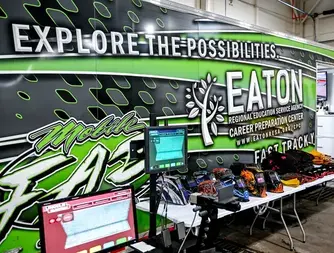
Eaton RESA's three mobile pathways labs bring career exploration options to thousands of students across the county.
Those include the Sky Lab, which is focused on aviation, featuring flight simulators and aviation engineering kits; the Fabrication Lab, dedicated to engineering manufacturing and fabrication jobs, which includes a 3D printer, drill press, and real welder; and The Garage Lab, which is focused on automotive trades, featuring tire changing stations, electrical circuit boards and a backhoe simulator, according to the district's website.
The grant will be dedicated to the fabrication and garage labs, said Sara Jobson, career pathways specialist for Eaton RESA.
The labs are typically geared toward elementary-aged students and highlight trades and career pathways that have corresponding programs in the higher grade levels. For example, elementary students can try a welding simulator through the manufacturing lab, and if they're interested, they can join the welding program when they're in high school.
The grant, which totals $116,917 from both the Michigan Economic Development Corporation and the Department of Labor and Economic Opportunity, is being used to provide new equipment like augmented reality welding systems to safely teach skills, 3D printers to model and prototype products, hybrid and electric vehicle system trainers to explore green-energy technology, a "robot dog" to introduce programming, and career tree visuals and STEM-themed books.
Vlad Lebedintsev, assistant superintendent for career and technical education at Eaton RESA, told the State Journal the funding is necessary to help update the equipment in the two older labs.
"This allows us to update a lot of our equipment on there to meet industry standard," he said. "Technology changes really quickly. There's a big focus on the semi-conductor and EV (electric vehicles) and mobility industry, which is the whole focus of what the grant was about."
Classes come to the lab for 45 minutes, where they get to see the different equipment and materials within the lab space. Jobson said her team prepares the lesson plans for the students and provides materials and worksheets.
High school students within the programs often help at the mobile labs, usually aiming to having at least one boy and girl partaking to have representation for the students. She said they usually try to get high school students from within the same district as the younger students so they can build connections.


